In the Eastern Orthodox Church, sacraments are ways in which we participate in the divine grace of God. We consider everything that is in and of the Church to be sacramental, because the Holy Spirit acts through everything that takes place within the Church. And everything the Holy Spirit does bestows grace upon us. However, the Church does name seven particular sacraments: Baptism, Chrismation, Eucharist, Confession, Holy Unction, Marriage, and Holy Orders. In this post, we explore these seven mysteries and explain their importance in the Life of the Church.
8 minutes
Table of Contents
What is a Sacrament?
Sacrament comes from the Latin word sacramentum, which means “a consecrated thing or act,” i.e., “something holy”. This is a translation of the Greek mysterion, which means “mystery”. Thus, in the Orthodox Church, we often call the sacraments the Holy Mysteries. This is simply because at their roots lies the mystery of Our Lord and Savior Jesus Christ, His relationship to God the Father and God the Holy Spirit, and His relationship to each of us. These are things we will never understand, because God’s essence and power is far beyond our grasp.
The sacraments, like the Church, are both visible and invisible. In every sacrament there is an outward visible sign, along with an inward spiritual grace. They are moments we experience only in the Life of the Orthodox Church, in which God reveals Himself to us and imparts His grace upon us.
Baptism
The first of the Holy Mysteries we all experience is Baptism, which brings us into the Church. Through this Mystery, we become part of the Body of Christ. As the priest submerges us into the waters three times (in the name of the Trinity), we die to the old ways of sin. Our sins are forgiven, and we are born again to a new life in Christ.
Read More: Orthodox Christian Baptism: Walking In Newness Of Life
Following the custom of the early Church, we encourage the baptism of infants because we believe baptism bears witness to God’s action of choosing a child to become part of His people. From the day of baptism, children, with the help of their family and the Church, will grow and mature in the life of the Spirit. Adults wishing to become Orthodox may experience this if there was no previous baptism in the name of the Trinity.
Chrismation
Chrismation (called Confirmation in Roman Catholic tradition) immediately follows baptism. The Orthodox often see this holy sacrament as our “personal Pentecost,” because it is through this Mystery that we receive the gift of the Holy Spirit through the Church.
In Chrismation, the priest anoints various parts of the body of the newly-baptized with Holy Oil. The oil is a sign of strength and consecration to God. Chrismation emphasizes that each person is a valuable member of the Church, including children. Moreover, it highlights that the Holy Spirit blesses each of us with certain gifts and talents. Our anointing also reminds us that our bodies are valuable and are involved in the process of salvation.
After Baptism and Chrismation, the newly-baptized usually receives holy communion, especially infants. There is never a time when the young are not part of God’s people.
Eucharist
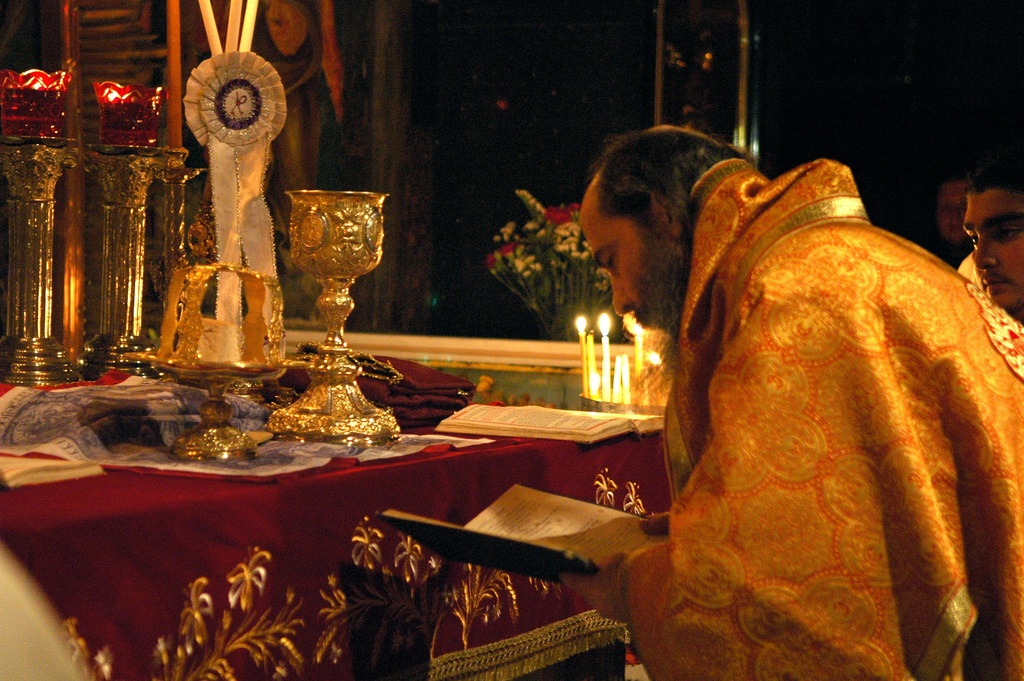
Holy Communion, often called the Eucharist (thanksgiving in Greek), is the Sacrament of sacraments in the Orthodox Church. We partake of the Eucharist during every Divine Liturgy. Unlike most other Christians, we believe the bread and wine used in this Sacrament become the literal Body and Blood of Christ, the Eternal Passover Lamb. However, unlike Roman Catholic theologians, we do not use terms like transubstantiation to try to explain how this is so.
This Sacrament is arguably the most important one in the Life of the Church for a few reasons. First, the Eucharist brings us into communion with Christ. Through this communion with Christ, we can progress toward theosis (salvation) and eternal life in the Kingdom of God. Secondly, it provides us with a source of strength for life and gives us forgiveness of our sins. When received with proper preparation, repentance, and fasting, communion draws us together into the fellowship of God’s people, His church, separating us from the forces of evil in this world.
Read More: On Abstaining From The Eucharist
Because partaking of Holy Communion is a confirmation of our unity in the Faith, only baptized Orthodox Christians in good standing can receive the Eucharist in our churches. This offends other Western Christians, but it shouldn’t. Why? Because shared communion is not the means to unity, but the expression of that unity.
Confession
When we sin, we distance ourselves from God, our fellow human beings, and our true selves. Penance (or Confession) is the Mystery through which we receive God’s forgiveness of our sins. After we confess our sins, our relationship with God and with others is restored and strengthened. We essentially go back to the fullness of our baptismal state, renewed in Christ. Through this Sacrament, Christ continues to heal those broken in spirit and restore the Father’s love to the lost.
The Church often reserves confession for periods of fasting, especially Great Lent; however, baptized Orthodox Christians can prepare for and go to Confession any time they feel the need. At a minimum, Orthodox Christians should confess at least once a year; some confess more frequently, though, from once a quarter to every time they prepare to receive the Eucharist.
Read More: What Does The Bible Really Say About Confession?
Holy Unction
Anointing of the Sick (Holy Unction) is the Orthodox Church’s sacrament of physical and spiritual healing. It reminds us that when we are in pain, Christ is present with us through the ministry of His Body, the Church. He is among us to offer strength to meet the challenges of life, and even the approach of death.
As with Chrismation, clergy use oil in this Sacrament as a sign of God’s presence, strength, and forgiveness. The Church offers unction to all who are sick in body, mind, or spirit, not just those near death. After reading seven epistle lessons, gospel lessons, and prayers devoted to healing, the priest anoints the body with the oil. The Orthodox Church celebrates this Mystery for all its members on Holy Wednesday during Great Lent.
Marriage
Through the Church’s Sacrament of holy matrimony, God (through the priest) joins a man and a woman as husband and wife. (Note: this differs from Roman Catholic practice, in which the man and woman confer the Sacrament on each other, with the priest serving only as a witness.) In marriage, they enter into a new relationship with God, the Church, and each other. One focused on mutual love and self-sacrifice.
According to Orthodox teachings, marriage is not simply a social institution or legal contract. It is an eternal vocation of the Kingdom of God that continues from this life into the age to come. The Holy Spirit calls husband and wife to share their Christian life together in all respects. Each, with the aid of the other, will grow closer to God. Therefore, not just anyone can marry in an Orthodox church. You must make sure you and your spouse fulfill certain requirements before a priest can officiate your marriage.
Despite the eternal nature of marriage, out of mercy the Church allows widows, widowers, and the divorced to remarry. However, the Church does discourage these second (and in extremely rare cases, third) marriages.
Holy Orders
The Holy Spirit preserves the continuity of the Orthodox Church through the Sacrament of Holy Orders. Through ordination, men chosen from within the Church serve as pastor, teacher, and representative of the parish. Each is also a living icon of Christ among His people.
Following the custom of the Apostolic Church, there are four major orders of the Church’s ministry, three of which have their own special ordinations:
- Bishop
- Priest
- Deacon
- Laity
The bishop is a successor of the Apostles, who used to serve as the main celebrant of the Divine Liturgy in the early Church. As the Church grew, bishops appointed priests and deacons to minister to parishes in their name. Each of these ministries has its own set of responsibilities. For instance, only a bishop may ordain others to the Deaconate or the Priesthood.
The Church ordains only men to become deacons, priests, or bishops. She permits men to marry before they enter the Holy Orders, but not after. This practice goes back to the earliest period in the history of the Church. We know some of the Apostles (the first “priests” of the Church) were married. Saint Paul also teaches that clergy are to be “husband of one wife”. Moreover, the 5th and 6th Ecumenical Councils state “if anyone wants to contract a legal marriage with a woman before being admitted to the clergy as subdeacon, or a deacon, or a presbyter previous to ordination, let him do so” (6th Canon). The same canon also says, “no…deacon or presbyter at all, [after ordination] has permission to contract a matrimonial relation for himself; if he should dare to do this, let him be deposed from office.”
Deaconesses
In the early Church, women were ordained to become deacons just as men. The Church ordained them because, in certain cultures, it was considered improper for male presbyters to touch female parishioners to baptize or anoint them. This practice eventually fell into disuse as society began to change and the taboo of men touching women faded away.
Some (although very few) jurisdictions of the Orthodox Church still have deaconesses today, especially in female monasteries.
Since the sixth century, Bishops have been chosen from the celibate clergy. Note that the Orthodox Church does not have women priests, because the priest is an image of Christ, who was male.
Conclusion
To summarize, the Orthodox Church places immense importance on the Sacraments. They function as pathways that bring the faithful closer to God. If one is Roman Catholic or Protestant, one may notice some similarities and/or differences between the Orthodox sacraments and one’s own.
Read More: The Teachings of the Orthodox Church
8 Responses
Hi, could you please explain to me or point me to a resource that can explain the Orthodox understanding of marriage in more detail? The Lord seems to be saying in Matthew 22:23-32 that people will no longer be married in the resurrection, but this brief synopsis of the Orthodox understanding seems to be saying that it is eternal, which would include the resurrection?
Thank you in advance for helping me to understand.
Mark,
Christ is risen! The important thing to remember in this passage is that Christ is focused on correcting the Sadducees’ errors regarding the nature of the resurrection, not of marriage. The Sadducees consider the resurrection to be a continuation of earthly life (including earthly, non-sacramental “marriage” as they understood it), and thus mock such a doctrine with an absurd scenario. Moreover, they fail to understand how Abraham and his sons can be alive in God even if they are physically dead. It is the clear teaching of Christ that the souls of the faithful who have departed this life are sustained before the face of God in anticipation of the final joy of the resurrection. In essence, Christ’s mention of marriage here is somewhat of a deflection. He effectively waves off the scenario presented, because it is unnecessary for Him to legitimize it. Instead He focuses on our being like angels, “incorruptible and immortal…filled with most chaste contemplations…sharing the gift of light to the understanding in our impassible and immaterial soul after the fashion of the exalted souls in heaven…” (St. Dionysios). And He focuses on examples from the first five books of the Old Testament, because the Sadducees rejected the Prophets, and thus Christ knew He could not reference those books to convict them.
If you would like to learn more about the Orthodox understanding of marriage, there are several fabulous books you can read on the subject. A few of our favorites are: One Flesh: Salvation Through Marriage In The Orthodox Church, by Fr. Lawrence Farley; The Sacrament of Love, by Paul Evdokimov; and Marriage: An Orthodox Perspective, by John Meyendorff.
God bless!
So if my spouse reposes before me, and is (God willing) in heaven where marriage no longer exists, then why do orthodox teach that it is better not to remarry?
Ahron,
Christ is in our midst! Thank you for this thoughtful and heartfelt question. The encouragement not to remarry is rooted in several spiritual and pastoral considerations. When a spouse passes away, the Church recognizes a unique opportunity for the surviving partner to turn even more fully toward God. This echoes St. Paul’s words in his first letter to the Corinthians, where he speaks of the blessings and spiritual focus that can come with celibacy or widowhood. The Church gently encourages widows and widowers to consider this path as a means of deeper devotion and prayer, not as a strict requirement but as a spiritual invitation.
At the same time, the first marriage is held in very high regard within Orthodox tradition. It is seen as a unique and unrepeatable sacrament, and out of respect for that sacred union, the Church views a second marriage as different. Permissible, but not celebrated in the same way. This is reflected in the prayers and tone of the service for a second marriage, which are more penitential and reflective. However, the Church is also deeply compassionate and understands the very real human need for companionship, support, and even family life, particularly for those who are younger or raising children. Remarriage after the death of a spouse is not looked upon as sinful or wrong; rather, it is sometimes the healthiest and most life-giving path for a person. The Church blesses those who choose to marry again, without judgment.
Ultimately, while marriage as we know it does not exist in the Kingdom of Heaven, the love and faithfulness cultivated within a Christian marriage are not lost. They are fulfilled and transformed in God’s presence. Choosing not to remarry can be a way of honoring that love and anticipating reunion in Christ, but it is a personal discernment, not a universal command. The Orthodox approach, then, is not about legalistic rules, but about guiding each person with wisdom, love, and pastoral sensitivity. If you’re interested in exploring this further, the writings of St. John Chrysostom and the prayers used in Orthodox marriage and widowhood services offer deeper insights into the Church’s heart on this matter. We hope this was helpful – God bless!
Hello! Are we, like Roman Catholics, forbidden to take the eucharist in a state of serious sin??? Because Roman catholics believe that if you are in a state of mortal sin, you must not receive the eucharist until you have gone to confession and cleansed yourself of mortal sin.
Jack,
Christ is in our midst! This is a very good question. In the Orthodox Church, we also take the Eucharist very seriously and recognize it as the true Body and Blood of Christ. Because of this, the Church teaches that we should always prepare our hearts before receiving Communion, and this includes examining our conscience and repenting of any serious (grave) sins. The Apostle Paul writes in 1 Corinthians 11:27-29 that “whoever eats the bread or drinks the cup of the Lord in an unworthy manner will be guilty of profaning the body and blood of the Lord.” This is why the Orthodox Church encourages confession, especially before receiving Communion, if we are aware of serious sin in our lives.
While Orthodox theology doesn’t use the same categories as “mortal” and “venial” sins (as in Roman Catholic teaching), the principle is similar: if you know you have committed a serious sin (like hatred, sexual immorality, theft, abuse, etc.), you should go to confession and receive forgiveness before approaching the chalice. This isn’t to make anyone feel unworthy forever, but to help us approach Christ with humility, sincerity, and a clean heart. God bless!
I myself am worried. looking at woman with lust is adultery, and adultery is a grave sin! but I just can’t resist looking at women with lust! it happens any chance it does! my eyes betray me! what must I do, if a grave sin becomes very common as that of a little sin, possibly even more???
Jack,
Thank you for your honesty and your desire to confront this struggle. Just recognizing and confessing the difficulty is already a step toward healing. In the Orthodox Church, we believe that the spiritual life is a continual battle, and all of us fall short in one way or another. What matters most is not being perfect (never falling), but always getting up again and turning back to Christ.
Looking at someone with lust is indeed a sin, as Christ teaches (Matthew 5:27–28), but the Church also understands human weakness and the constant spiritual warfare we face, especially in today’s world, where temptations are everywhere. The fact that you are worried shows that your conscience is alive and that you care about your relationship with God.
First, do not despair. The Fathers teach that despair and hopelessness are traps of the enemy. St. John Climacus says, “Do not be surprised if you fall every day; do not give up, but stand your ground courageously. And assuredly, the angel who guards you will honor your patience.” (The Ladder, Step 5). Bring your struggle to Christ in confession (or in personal prayer if you are not Chrismated or unable to make it to an Orthodox church), trusting in His mercy and the healing power of the sacrament. Confession is not only for “rare” or “special” sins, but for our daily battles and weaknesses. The goal here is not to become scrupulous or to fall into shame, but to fight with humility. Admit your weakness before God, and ask for His strength each day. Even the struggle itself, offered to God, is pleasing to Him.
When you catch yourself falling, immediately turn your mind and heart to Christ — say the Jesus Prayer (“Lord Jesus Christ, Son of God, have mercy on me, a sinner”) or another short prayer. Additionally, try to avoid situations or media that make the struggle harder, as much as you are able. This means fasting not only from food but also from images and thoughts that fuel the temptation.
Above all, remember that the Church’s discipline is gentle for those who are sincerely struggling and repenting. If someone is sincerely repentant and struggling, they should not let shame keep them from the chalice, unless specifically advised by one’s priest. The Eucharist is “medicine for immortality” and helps us in our weakness. Always speak openly with your confession father or parish priest, who can guide you personally.
St. Isaac the Syrian writes: “Never say that God is just. If He were just, you would be in hell. Rely only on His injustice, which is mercy, love, and forgiveness.” God’s mercy is greater than any sin, no matter how frequent the struggle. You are not alone. The Church is a hospital for sinners, not a museum for saints. Keep struggling, keep confessing, keep turning back to Christ. With His help, every temptation can become an opportunity for repentance and growth. God bless you!