The Fourth Ecumenical Council, held at Chalcedon in 451, stands among the most important councils in the history of the Orthodox Church. The Council addressed a question at the heart of the Christian faith: Who is Jesus Christ? The Fathers of Chalcedon confessed Jesus Christ as one Person, fully God and fully man. Their Definition of Faith gave the Church precise language for confessing the mystery of the Incarnation and continues to shape Orthodox Christian faith and worship.
The Council also addressed serious disputes that had troubled the Church after the Third Ecumenical Council. The bishops examined earlier decisions, considered the writings of prominent theologians, and defended the apostolic faith received by the Church. They also established canons that addressed clergy, monastic life, Church administration, marriage, and other aspects of ecclesiastical order.
Orthodox Christians continue to remember the Fathers of Chalcedon in the Church’s liturgical life. The traditions surrounding the Council also preserve the memory of saints such as the Great Martyr Euphemia, whose relics were present when the bishops gathered.
In this article, we will explore the events that led to the Fourth Ecumenical Council, what happened at Chalcedon, and the theological decisions that emerged from it. We will also examine its canons and the stories preserved in Orthodox tradition. Together, these give us a fuller picture of why Chalcedon remains important to the life and faith of the Church.
10 minutes
Why was the Fourth Ecumenical Council necessary?
The Fourth Ecumenical Council followed years of controversy over how the Church should confess the Person of Jesus Christ. The Third Ecumenical Council, held at Ephesus in 431, defended the faith that Jesus Christ is one Person and proclaimed the Virgin Mary as Theotokos, or “Mother of God.” St. Cyril of Alexandria played a central role in defending this teaching against Nestorius, whose Christological language the Church judged to divide Christ’s divine and human realities.
The controversy continued after Ephesus. Questions arose about how the Church should speak about Christ’s humanity while preserving the unity of His Person. One of the most controversial figures in this dispute was Eutyches, an influential monk in Constantinople.
In 448, St. Flavian, the Patriarch of Constantinople, examined Eutyches and condemned his teaching. The dispute soon reached the emperor, the patriarchates, and Pope Leo of Rome. A council met at Ephesus in 449, but its proceedings became so coercive and violent that later Orthodox tradition called it the “Robber Council.”
The Church therefore faced both a theological crisis and a serious disruption of ecclesiastical order. The need for a clear and faithful confession of the Orthodox understanding of Christ had become increasingly urgent.
Two years later, Emperor Marcian called a new council at Chalcedon. The bishops gathered to examine the controversy, address the abuses of the previous council, and confess faithfully the faith received by the Church.
The Council of Chalcedon begins
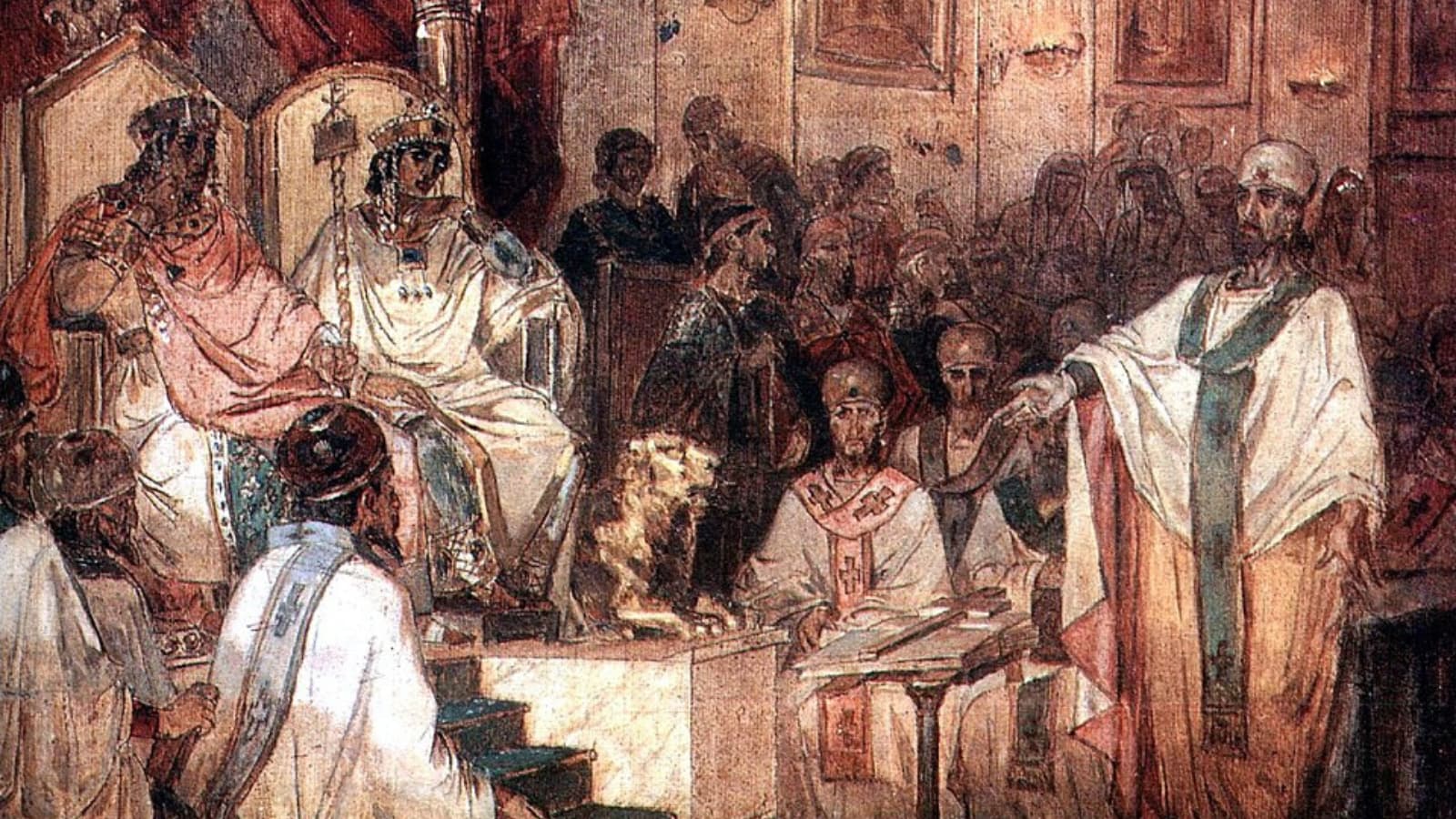
Emperor Marcian and Empress Pulcheria called the Fourth Ecumenical Council in 451 to address the controversy that had troubled the Church. Bishops and their representatives gathered at Chalcedon, a city across the Bosporus from Constantinople. The Council met in the Church of St. Euphemia the Great Martyr. Around 630 bishops participated, making Chalcedon the largest of the Seven Ecumenical Councils.
Imperial officials attended to maintain order and oversee the proceedings, while the bishops examined the questions of faith before the Church. The Council first reviewed the proceedings of Ephesus in 449, including the treatment of St. Flavian and the actions of Dioscorus, Patriarch of Alexandria.
The bishops then examined the writings of earlier Fathers and the decisions of previous councils. They gave particular attention to the teaching of St. Cyril of Alexandria and to the Tome of St. Leo the Great, Bishop of Rome. The Council compared these teachings with the faith already received by the Church.
The bishops received teachings that agreed with the faith of the earlier Ecumenical Councils and the Fathers. Their work therefore continued the Church’s established conciliar tradition rather than introducing a new doctrine. When the Tome of St. Leo was read, the bishops acclaimed its agreement with the apostolic faith, yet they still examined its teaching within the wider Tradition of the Church.
The Council’s deliberations eventually produced the Definition of Faith of the Fourth Ecumenical Council. This definition would give enduring expression to the Church’s confession of Jesus Christ as fully God and fully man, united in one Person.
The Definition of Faith at Chalcedon
The central question before the Fourth Ecumenical Council concerned the mystery of the Incarnation. Christians already confessed that the eternal Son of God had truly become man, but the Fathers needed to express clearly how His divinity and humanity belong together.
The Nicene Creed calls Christ “true God of true God” and “of one essence with the Father.” He also possesses a complete human nature. He was born, grew, became weary, suffered, died, and rose again. His humanity includes a human body and a rational human soul.
The Fathers of Chalcedon therefore confessed Jesus Christ as one and the same Son, “perfect in Godhead and perfect in manhood.” He exists in two natures, divine and human, united in one Person, or hypostasis.
The Fathers described this union with four important terms:
Without confusion: His divinity and humanity do not blend into a new nature.
Without change: His divine nature remains fully divine through the Incarnation.
Without division: Christ is one Person, not two.
Without separation: His divine and human natures remain united in that one Person.
This confession also explains why the Church calls the Virgin Mary Theotokos. The Person born from her according to the flesh is the same eternal Son who exists before all ages.
Chalcedon thus gave precise language to the mystery of the Incarnation. The Son of God truly assumed our humanity while remaining what He eternally is. This teaching continues to shape Orthodox Christian faith and worship, as the Church confesses the same Christ who became man for our salvation.
The canons of the Council of Chalcedon
The Fourth Ecumenical Council also issued canonical regulations concerning the practical life and governance of the Church. These canons addressed matters such as simony, clergy conduct, monastic life, ecclesiastical jurisdiction, marriage, and Church property.
Together, they provide a valuable picture of how the Church ordered her life in the fifth century. They also show how the Fathers applied the principles of the Christian faith to concrete pastoral and ecclesiastical matters.
For example, Canon 2 condemns simony, the buying or selling of ecclesiastical office. Canon 4 places monasteries and monks under the proper oversight of the bishop. Canon 19 requires provincial synods to meet twice each year so that bishops can address ecclesiastical concerns together. And canon 26 calls for responsible administration of Church property through qualified stewards.
These regulations also address matters such as clergy changing churches, accusations against clergy, the responsibilities of deaconesses, consecrated virgins, and the proper boundaries of ecclesiastical authority.
A complete translation of the Canons of the Council of Chalcedon can be found here.
Among the canons, Canon 28 deserves particular attention. It addresses the ecclesiastical privileges of Constantinople and became an important point of disagreement between Rome and Constantinople. We will examine its history and significance separately.
Canon 28 and the place of Constantinople
Among the canons associated with the Fourth Ecumenical Council, Canon 28 has particular historical importance. It concerned the position of the See of Constantinople within the ecclesiastical order of the Church.
The canon recognized Constantinople as holding the second place after Rome because the city served as the imperial capital. It also granted the bishop of Constantinople authority to ordain certain bishops in the dioceses of Pontus, Asia, and Thrace. The bishops grounded these privileges in Constantinople’s civil and political importance within the Roman Empire.
The Roman representatives at Chalcedon opposed this canon, and Pope Leo the Great rejected it. Leo accepted the Council’s Christological Definition but objected to the reasoning behind Constantinople’s elevated position. His position emphasized the apostolic standing of the Roman See rather than the city’s status as the imperial capital.
Canon 28 therefore became an important point in the developing differences between Rome and the churches of the East. It should not, however, be read as though the later divisions between Eastern and Western Christianity had already taken their final form in 451. The disputes surrounding primacy, jurisdiction, and ecclesiastical order developed over many centuries.
For the Orthodox Church, Canon 28 remains important because it reflects the conciliar understanding of ecclesiastical order and the relationship among the major episcopal sees. Its history also helps explain later disagreements about the nature and extent of Roman primacy.
Chalcedon and the Oriental Orthodox Churches
The Fourth Ecumenical Council became a major point of division among Christians in the East. Several ancient churches did not accept the Council of Chalcedon or its Definition of Faith. Over time, these churches developed into the communion now known as the Oriental Orthodox Churches, which includes the Coptic, Armenian, Ethiopian, and Syriac Orthodox Churches.
The controversy involved both theological language and differing interpretations of the teachings of earlier Fathers, particularly St. Cyril of Alexandria. Those who rejected Chalcedon feared that its language of Christ being “in two natures” compromised the unity of Christ’s Person and opened the door to Nestorianism. The Chalcedonian churches, meanwhile, understood the Definition as a faithful expression of St. Cyril’s teaching and the apostolic faith.
The division deepened through political, cultural, and ecclesiastical circumstances during the following centuries. Despite later efforts to restore unity, the two families of churches remained separate.
Modern theological dialogue has brought greater clarity to the historical controversy. Orthodox and Oriental Orthodox theologians have found substantial agreement in their confession of Christ, including the affirmation that He is one Person and truly God and man. Some official dialogue statements have concluded that the two traditions have often used different Christological terminology to express essentially the same Orthodox faith.
Full communion, however, has not been restored. The Orthodox Church continues to receive the Fourth Ecumenical Council as an authoritative expression of the apostolic faith and regards the Oriental Orthodox Churches as separated from her sacramental communion.
St. Euphemia and the Miracle of Chalcedon
The Church of St. Euphemia in Chalcedon held the relics of the Great Martyr Euphemia when the Fourth Ecumenical Council gathered in 451. Orthodox tradition remembers her as a witness to the faith proclaimed by the Council.
According to the tradition, the bishops reached a point where the opposing sides could not resolve their disagreement. Patriarch Anatolius of Constantinople proposed entrusting the matter to God through the intercession of St. Euphemia. Each side wrote its confession of faith on a separate scroll and sealed it. The bishops then placed both scrolls inside the saint’s tomb and sealed it under guard for three days. During that time, the bishops fasted and prayed.
When the tomb was opened, Orthodox tradition says that St. Euphemia held the scroll containing the Orthodox confession in her right hand. The other scroll lay at her feet. According to the account, she then extended her hand and gave the Orthodox confession to Patriarch Anatolius.
The Church has continued to preserve this event as a miracle through which God confirmed the faith confessed at Chalcedon. Orthodox Christians commemorate St. Euphemia’s role in the Council on July 11, while her martyrdom receives a separate commemoration on September 16. Her troparion for July 11 specifically remembers her as confirming what the Fathers of the Fourth Council taught.
The story also beautifully connects St. Euphemia’s earlier martyrdom with her later witness. She first confessed Christ under persecution in pagan Chalcedon. Nearly 150 years later, the Church remembered her as a witness to the truth of Christ’s Incarnation.
Why the Fourth Ecumenical Council still matters
The Fourth Ecumenical Council remains important because it gave lasting expression to the Church’s faith in Jesus Christ. At Chalcedon, the Fathers confessed the mystery of the Incarnation with precision, protecting the truth that the eternal Son of God truly became man while remaining fully divine.
The Council also reminds us that the Orthodox faith lives within the Church’s worship, Tradition, and conciliar life. The bishops examined the controversies of their time in light of the faith handed down through the Apostles and Fathers. Their canons likewise show the Church applying that faith to the practical ordering of her life.
For Orthodox Christians today, Chalcedon is therefore more than an event from the fifth century. The Church continues to confess the Christ whom the Fathers defended, celebrate the saints who witnessed to Him, and preserve the Tradition they handed down.
The Fourth Ecumenical Council teaches us to approach the mystery of Christ with faith, reverence, and careful attention to the life of the Church. Its confession remains the faith we receive, worship, and seek to live as members of Christ’s Body.
Keep Reading: Who Exactly Is Jesus Christ?