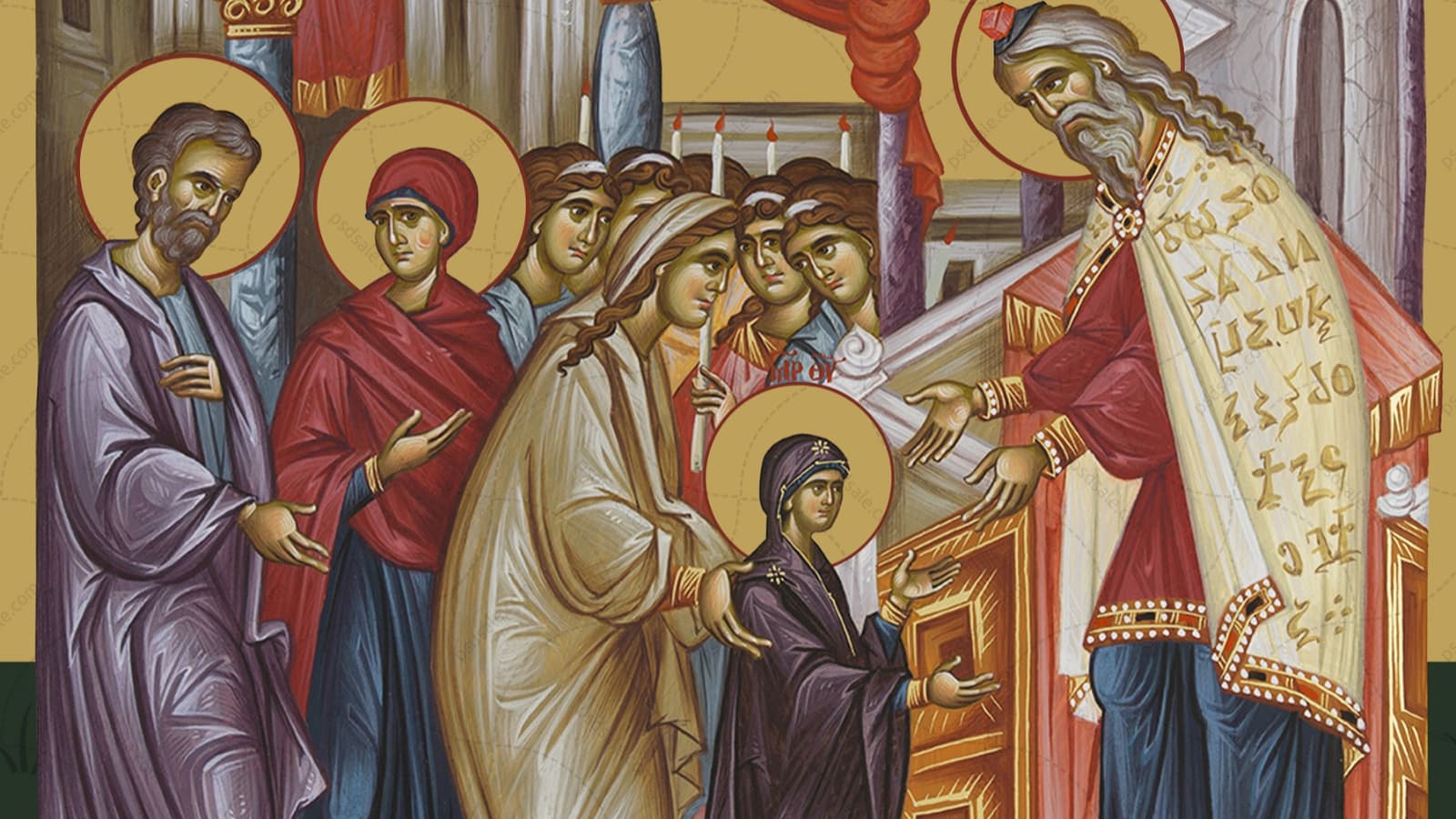
Every year on November 21, the Orthodox Church celebrates the Entrance of the Theotokos into the Temple. This feast commemorates the day Saints Joachim and Anna brought the young Virgin Mary to the Temple in Jerusalem. Though you will not find it in the canonical Gospels, the Church’s sacred Tradition has preserved and celebrated it for centuries as one of the Twelve Great Feasts of the Church.
But why does the Church commemorate an event from Mary’s childhood? The answer reaches far beyond the story of a little girl entering the Temple. The feast reveals God’s preparation for the Incarnation of Jesus Christ and the extraordinary role Mary would play in His coming into the world. The Temple had long been the place where God’s presence dwelt among His people. Now, the Church celebrates the entrance of the one who would herself become the living Temple of God, bearing the eternal Son in her womb.
The Entrance of the Theotokos invites us to reflect on Mary’s faithfulness, the mystery of the Incarnation, and our own calling to prepare our hearts to receive Christ.
8 minutes
The story of the Theotokos’ presentation in the Temple
The account of the Virgin Mary’s entrance into the Temple comes to us not from the canonical Gospels. Instead, it comes from an early Christian text known as the Protoevangelium of James. Although this work is not part of the New Testament, its account became deeply woven into the Church’s liturgical Tradition. According to the traditional account, Mary’s parents, Saints Joachim and Anna, had long endured the sorrow of childlessness. In their old age, they prayed fervently for a child and promised to dedicate that child to God. When Mary was born, they received her as an answer to their prayers. And when she was three years old, brought her to the Temple in Jerusalem to fulfill their promise.
The hymns of the feast describe Mary ascending the Temple steps, welcomed by the high priest Zacharias and led into the sanctuary. There, she would remain, growing in wisdom and holiness as she prepared for the unique calling God had appointed for her. The Church’s tradition even speaks of her being nourished by an angel, emphasizing that her life was sustained by God’s grace.
The significance of this moment becomes clearer when we remember what the Temple represented. It was the sacred place where God had chosen to dwell among His people, the center of Israel’s worship and the sign of His presence with them. And now, a little girl was being brought into that holy place—one who would herself become the dwelling place of God when she received the Word into her womb.
The feast, then, is not simply a commemoration of Mary’s childhood or a story about her parents’ devotion. It celebrates the beginning of her preparation for the mystery of the Incarnation.
Why did Sts. Joachim and Anna bring the Virgin Mary to the Temple?
Joachim and Anna’s decision to bring their young daughter to the Temple was an act of gratitude, faith, and devotion. After years of longing for a child, they had received Mary as a gift from God. Their promise to dedicate her to Him was not an attempt to repay a debt, but a response of love: they recognized that the child entrusted to their care ultimately belonged to God.
Their example reveals something important about the Christian understanding of parenthood. Children are not possessions to be shaped according to our ambitions or held as though their lives belong to us. They are gifts entrusted to our care, each with a life and calling known fully to God. A parent’s vocation is not simply to provide for a child’s earthly needs, but to help that child grow in faith, love, and communion with Him.
Joachim and Anna could not have known all that awaited their daughter. They could not yet have understood the full mystery of the role she would one day fulfill in the salvation of the world. Yet they offered her to God in trust, placing her future in His hands.
Their offering also reminds us that devotion to God is not confined to the walls of a church. It begins in the home, in the prayers we offer, the faith we practice, and the love with which we care for those entrusted to us. In bringing Mary to the Temple, Joachim and Anna offered God not merely a child, but the very person they loved most—a beautiful expression of gratitude and trust.
Mary, the Living Temple of God
To understand the deeper meaning of this feast, we must first understand what the Temple represented. In the Old Testament, the Temple in Jerusalem was the dwelling place of God’s presence among His people. Within its sanctuary rested the Ark of the Covenant, which held the tablets of the Law and signified God’s presence with Israel. Yet the Temple and the Ark also pointed toward something greater: the coming of Jesus Christ, the eternal Son of God, who would take on human nature and dwell among us.
This is why the Church honors Mary as the living Temple of God. The God whom the Temple could not contain entered the world through her, taking His flesh from her womb. Just as the Ark carried the tablets of the Law, Mary bore Christ, who is the fulfillment of the Law. She became the dwelling place of the Most High—not because she was divine herself, but because the eternal Son truly became man through her.
This mystery is also at the heart of Mary’s title, Theotokos, meaning “God-bearer” or “Mother of God.” The title proclaims that the One she bore was not merely a holy man or prophet, but God the Word Himself, made flesh. Seen in this light, Mary’s entrance into the Temple takes on profound significance. The young girl brought into God’s house would one day become the living sanctuary through whom God entered His creation to save the world.
What this Feast teaches us about holiness
The Entrance of the Theotokos also invites us to reflect on our own calling to holiness. Mary’s life was uniquely prepared for the coming of Christ, but her example reminds us that our relationship with God is not passive. He invites us to respond freely to His grace, allowing Him to shape our hearts and draw us into communion with Him.
In the Orthodox Church, we call this cooperation between God’s grace and our willing response synergy. We do not make ourselves holy through our own efforts, nor can we earn God’s love. Rather, we receive His grace and continually choose to turn toward Him through prayer, repentance, worship, and love.
Mary’s holiness was not the result of a single moment at the Temple. Her entire life became an offering to God, culminating in her willing response to the angel Gabriel: “Behold the maidservant of the Lord! Let it be to me according to your word” (Luke 1:38). Her yes made possible the coming of Christ in the flesh.
We cannot share Mary’s unique role in the mystery of the Incarnation, but we can follow her example of trust and faithfulness. The feast asks us to consider whether we are making room for God in our own lives. Have we prepared our hearts to receive Christ? Are we offering Him not merely our words, but our time, our choices, and our whole selves?
How the Orthodox Church celebrates the Feast
The Church celebrates the Entrance of the Theotokos each year on November 21. The feast’s hymns are especially rich in imagery drawn from the Old Testament. Mary is praised as the living Temple, the Ark of the Covenant, and the sacred dwelling place of the Almighty. These titles point beyond Mary herself to the mystery of Christ’s coming. The God who once dwelt among His people in the Temple now comes into the world in human flesh.
The feast also falls during the Nativity Fast, the period of prayer, fasting, and spiritual preparation leading up to the celebration of Christ’s birth. Its timing is significant. As the Church prepares to welcome the incarnate God, we first celebrate the woman through whom He entered the world. The Entrance of the Theotokos reminds us that the Nativity is not an isolated event. Rather, it is the fulfillment of God’s work of salvation, prepared throughout the history of His people.
In celebrating this feast, we are invited to join Mary in preparing to receive Christ—not only by observing the fast, but by cultivating prayer, humility, repentance, and love.
What can we learn from the Entrance of the Theotokos?
The Entrance of the Theotokos reminds us that a life devoted to God is formed through countless acts of faithfulness. Joachim and Anna entrusted their beloved daughter to God’s care, and Mary grew into the fullness of the calling He had prepared for her. Their example invites us to consider what we, too, are willing to place in God’s hands.
For parents, this feast offers a reminder that raising children is a sacred responsibility. We cannot determine the course of their lives or protect them from every hardship. But we can teach them to know God, surround them with prayer, and encourage them to seek His will. Like Joachim and Anna, we are called to entrust those we love to His care.
For all of us, Mary’s example points toward a deeper question: Are we willing to let God shape our lives? Preparing a place for Christ requires more than occasional religious observance. It means turning away from sin, cultivating humility, forgiving others, and making prayer an essential part of our daily lives.
Preparing our hearts to receive Christ
The Entrance of the Theotokos is far more than a remembrance of an event from Mary’s childhood. It celebrates God’s preparation for the Incarnation and honors the woman who would become the living Temple of the eternal Son. Through her willing response to God’s grace, Jesus Christ took on human flesh and entered the world for our salvation. As we celebrate this feast during the Nativity Fast, let us remember that we, too, must prepare a dwelling place for God within our hearts. May the example of the Theotokos inspire us to grow in faith, humility, and love, so that we may welcome Christ not only at Christmas, but throughout every day of our lives.
Most Holy Theotokos, save us!
Keep Reading: Do Orthodox Christians “Worship” Mary?