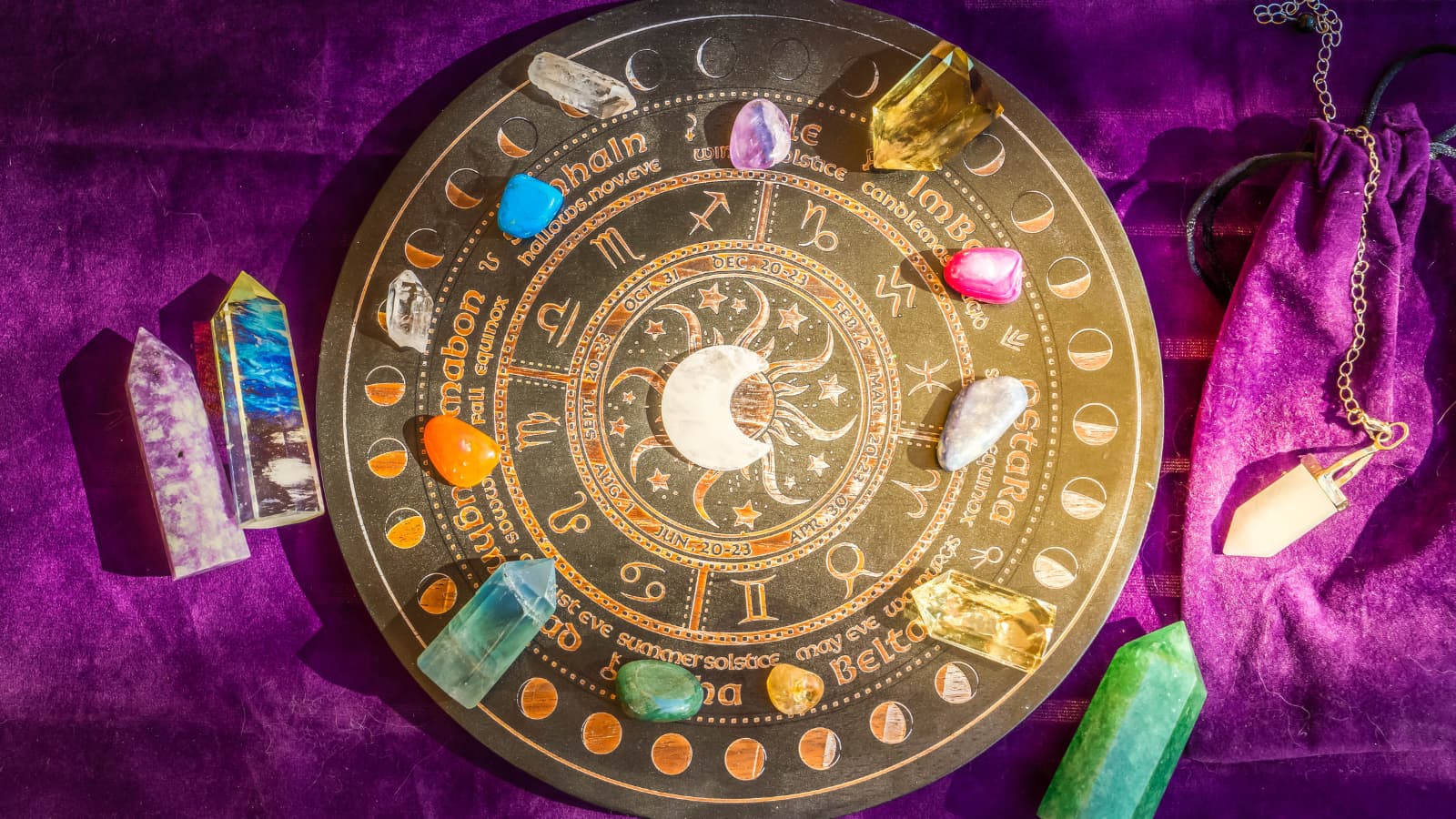
Crystals have become increasingly popular in recent years—not only for their beauty, but also for their supposed spiritual properties. Many people encounter claims that crystals can heal, protect, or channel energies. Understandably, Orthodox Christians may wonder: What is the Church’s perspective on these practices? Let us consider this matter together, drawing from the theological, historical, and pastoral wisdom of the Orthodox tradition.
5 minutes
The goodness of creation
The Eastern Orthodox Church affirms the fundamental goodness of all creation, including minerals and crystals. As the Book of Genesis tells us, God saw all that He had made and declared it “very good” (Genesis 1:31). Crystals, with their natural beauty and intricate form, bear witness to God’s creative power. Throughout history, the Church has even adorned her temples and sacred vessels with precious stones, using them to glorify God.
It is important, therefore, to recognize that crystals themselves are not inherently harmful or evil. To admire them for their beauty or to use them as decorative objects poses no spiritual issue. The concern arises only when spiritual or supernatural powers are attributed to these objects.
On attributing spiritual power to crystals
The Orthodox Church teaches that true healing, protection, and spiritual growth come from God alone. The Church warns that turning to practices that ascribe independent power to created things (like crystal healing) can lead to superstition—and, in some cases, even idolatry.
Assigning spiritual efficacy to material objects apart from God’s will overlooks the fundamental truth that all power and grace flow from the Holy Trinity. Seeking spiritual benefits from crystals or similar objects can also open the door to spiritual confusion and, potentially, deception. The Church’s guidance is always to seek God’s grace through prayer, repentance, the sacraments, and the life of the Church.
Veneration versus magic
But Orthodox Christians venerate icons, relics, and the Cross. How is this different from using crystals for spiritual benefit?
In Orthodox practice, we venerate holy objects not because the objects themselves possess any magical or inherent power. We do so because they serve as tangible links to the divine. For example, when we venerate an icon, we are not worshipping the wood and paint. Instead, we honor who or what the icon represents—Christ, the Theotokos, or the saints. The honor shown to the icon passes to its prototype. Similarly, we honor relics not as sources of power. Rather, because they are connected to the lives of holy people through whom God’s grace has worked.
The Church blesses these objects through prayer, and their significance lies in their relationship to God and to the communion of saints. They are, in a sense, windows to the divine—means by which we are reminded of God’s presence and mercy.
In contrast, the use of crystals in New Age or occult practices is based on the belief that the object itself possesses power, apart from any relationship to God or His saints. This approach treats the material as a source of independent spiritual energy, which is fundamentally at odds with Orthodox Christian theology. In Orthodoxy, material things may become “bearers” of grace only through God’s action and purpose, never by their own nature.
This distinction guards against the danger of superstition—placing trust in created things rather than in the Creator. The Church’s use of holy objects always points us back to God, inviting prayer, humility, and communion with Him. Magic or superstition, on the other hand, seeks power or control apart from God’s will, which can lead us away from genuine faith.
The Orthodox path to healing and protection
The Orthodox Church encourages her faithful to seek healing and protection through Christ. The primary means to do this are through prayer, participation in the sacraments, the anointing of the sick, and the use of holy water or oil. The Church also affirms the appropriate use of medicine and the natural sciences within God’s providence.
Related: The Power of the Jesus Prayer
Crystals, though beautiful, do not have a place within the spiritual or liturgical life of the Church. We may enjoy them as part of the natural world. But they are not considered instruments of spiritual power or healing.
Pastoral guidance
It is not uncommon for people today to be drawn to crystals, whether out of curiosity, a desire for healing, or a search for meaning. The Church understands these longings and meets them with empathy and spiritual care.
If you or someone you know has become interested in crystals for spiritual reasons, the most important first step is not to react with fear or shame. Instead, the Church invites all her members to approach these questions honestly, with a desire to grow closer to Christ. Orthodox priests and spiritual fathers are available to listen without judgment and to offer guidance rooted in love and truth. Their role is not to condemn, but to help us discern the best way forward for our spiritual health.
The Church’s centuries-old wisdom affirms that the deepest healing and protection are found in Christ Himself, through the sacramental life and the support of the Christian community. If you have questions or uncertainties, bringing them to your parish priest can offer clarity and peace. Sometimes, what draws us to non-Christian spiritual practices is a sign of a deeper spiritual hunger—a hunger that the Orthodox tradition, with its rich sacramental life and profound prayer, is uniquely equipped to satisfy.
Above all, the Church encourages us to trust in God’s love and providence. We are not left to navigate the spiritual life alone; Christ is always present, and the Church is here to accompany us on the journey.
Conclusion
The Orthodox Church appreciates the beauty of crystals as part of God’s creation, yet does not endorse their use for spiritual or magical purposes. Orthodox Christians are called to seek healing, protection, and spiritual growth through Christ and the life of the Church, rather than through the energies or supposed powers of material objects.
For those wishing to deepen their understanding of Orthodox spirituality, speaking with a parish priest or reading the works of the saints and spiritual elders—such as the Philokalia—can be especially helpful. The Orthodox tradition offers profound guidance for all who desire authentic spiritual life.
Keep Reading: Why Orthodox Christians Should Avoid Tarot Cards
2 Responses
Hello! This is neat, but I do have questions. What about the three magi??? didn’t they practice astrology and study the stars???
Jack,
Christ is in our midst! Thank you for your question. This often comes up in discussions about the Magi and the Nativity story. The Gospel of Matthew tells us that the Magi were “wise men from the East” who followed a star to Bethlehem. Tradition holds that they were likely scholars or priests from Persia, and that their knowledge included astronomy and, possibly, elements of astrology as understood in their culture. However, the Orthodox Church does not see the Magi as endorsing astrology or the use of crystals or other esoteric practices.
Instead, the story is understood as a profound example of God meeting people where they are. The Magi, in their search for truth, were led by a star—not by their own power, but by God’s providence. In Orthodox hymnography and teaching, the star is seen as a miraculous sign, not an ordinary astrological event. The Fathers often emphasize that, in coming to Christ, the Magi left behind their former practices and recognized Jesus as the true Light of the world. So, while the Magi may have studied the stars, their journey is not a validation of astrology or occult practices. Rather, it is a testimony to how God can guide sincere seekers — even through imperfect means — ultimately to the Truth found in Christ. After encountering Christ, the Magi worshipped Him and departed by another way, symbolizing their changed lives and new direction. God bless!