Blended families are becoming increasingly common, both within society and within the Orthodox Church. Whether formed after the death of a spouse, divorce, remarriage, or other unexpected circumstances, many Orthodox Christian families find themselves asking questions they never imagined they would face. How do we build one Orthodox Christian home when our family comes from two different histories? What can we do to help children adjust to a new parent or new siblings? How do we navigate prayer, church attendance, fasting, and feast days when children move between two households—especially if one of them is not Orthodox?
If these questions sound familiar, you are not alone. Many Orthodox Christians quietly wrestle with the joys and challenges of blending two families while striving to remain faithful to Christ and His Church. The good news is that the Orthodox Church has never expected families to be free from hardship before they begin growing in holiness. She has always been a place where brokenness encounters the healing grace of Christ.
No two households follow the same path. Some are shaped by widowhood, adoption, remarriage, military service, illness, or children brought together from different homes. Yet every Orthodox Christian family shares the same calling: to become a place where Christ is welcomed, love is lived sacrificially, forgiveness is practiced freely, and every member grows in the likeness of God.
This article cannot provide easy answers for every situation. However, we pray that it offers a pastoral starting point—grounded in the wisdom of the Orthodox Church—to help blended families build a home where Christ remains at the center.
17 minutes
Table of contents
- What does the Orthodox Church teach about blended families?
- Every blended family begins with two histories
- How to build an Orthodox Christian home in a blended family
- Creating new family traditions without erasing old ones
- Orthodox step-parenting: Lead with love before authority
- Raising Orthodox children in a blended family
- Navigating relationships in a blended family
- Healing together as a family
- Building a family Is a lifelong work of Grace
What does the Orthodox Church teach about blended families?
From the beginning, the Orthodox Church has understood marriage as a sacred union established by God (Matt. 19:6) and an image of Christ’s union with His Church (Eph. 5:31–32). Marriage is not simply a legal arrangement, but a lifelong vocation in which husband and wife help one another grow in holiness.
At the same time, the Church also recognizes the painful reality of our fallen world. Death, divorce, abandonment, addiction, abuse, and other tragedies can reshape a family’s life in ways no one desired. Rather than ignoring this brokenness, the Orthodox Church responds with both truth and mercy.
For this reason, the Church has long exercised oikonomia—pastoral discretion rooted in Christ’s compassion. While marriage remains sacred and lifelong in its intention, the Church may permit remarriage after divorce or the death of a spouse under appropriate pastoral guidance. This is not a lowering of the Church’s teaching, but an expression of God’s desire to bring healing where life has been wounded.
A blended family should never think of itself as a “second-class” Christian family. As St. John Chrysostom reminds us, every Christian home is “a little Church.” That calling does not require having a perfect past, but instead depends on welcoming Christ into the life of the family today. Whatever burdens your household carries, the invitation remains the same: to grow together in repentance, forgiveness, love, and communion with God.
Every blended family begins with two histories
Unlike newlyweds beginning life together for the first time, blended families bring years of memories, relationships, traditions, joys, and wounds into a shared home. Children may grieve the loss of a parent or the life they once knew. Parents may carry regrets, while stepparents often wonder where they belong in relationships that began long before they arrived.
One temptation is to believe that healing requires forgetting the past. Yet Orthodoxy teaches the opposite. We commemorate the saints, pray for those who have fallen asleep in the Lord, and remember God’s faithfulness throughout history. Holy remembrance is not the enemy of healing—it is often part of healing itself.
That means children should be free to speak about a parent who has died, cherish old photographs, or remember family traditions without fearing they are hurting someone they love. A family grows stronger not by erasing its history, but by entrusting every chapter of that history to Christ.
This journey rarely follows a predictable timeline. Younger children may adapt quickly, while teenagers often need more time to process change and build trust. Even after years of patient effort, relationships may still feel unfinished. Do not mistake slow growth for failure. Faithfulness is measured not by how quickly a family feels “normal,” but by whether Christ continues to be welcomed into its daily life.
As the Apostle Paul reminds us, “I planted, Apollos watered, but God gave the increase” (1 Cor. 3:6). Parents are called to love faithfully; the work of transforming hearts ultimately belongs to God.
How to build an Orthodox Christian home in a blended family
No household becomes an Orthodox Christian home simply because the people living under one roof share the same last name. Whether a family begins with newlyweds, adoption, remarriage, or the blending of two households, a Christian home is built as each person gradually learns to place Christ at the center of daily life.
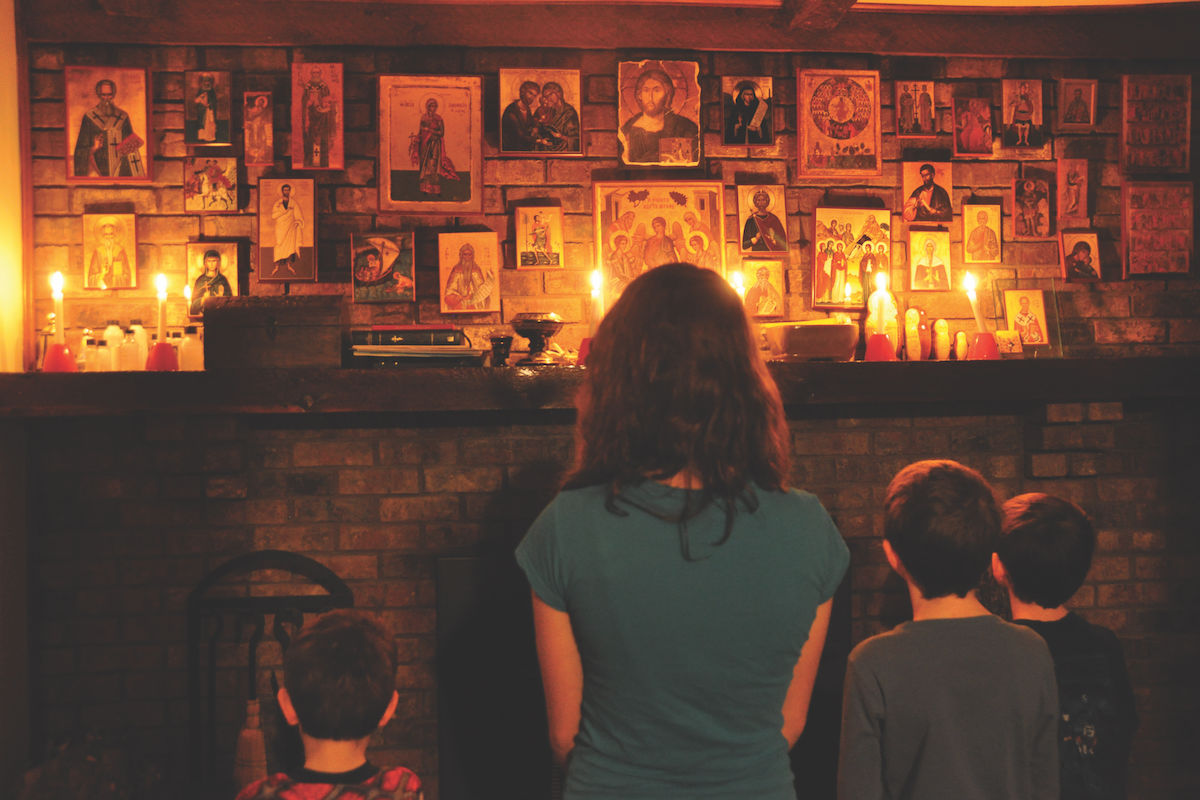
This transformation rarely happens through dramatic moments. More often, it grows through ordinary acts of faithfulness. Morning and evening prayers, gathering before the icons, attending the Divine Liturgy, reading the Scriptures, observing the Church’s fasting seasons, and asking one another’s forgiveness all become quiet reminders that Christ is the true Head of the household.
For blended families, these shared practices become especially meaningful. They create a common rhythm that belongs to everyone—not by erasing each person’s past, but by giving the family a shared future rooted in Christ.
Children often learn the Orthodox faith less from formal lessons than from the life they see lived before them. They notice parents who pray together, forgive one another, receive Holy Confession, and faithfully return to the Eucharist week after week. Long before they can explain the faith, they begin to recognize its shape.
Homes do not transform overnight. Yet every small act of faithfulness becomes another stone laid upon the foundation Christ Himself is building.
Creating new family traditions without erasing old ones
Every family has traditions. Some revolve around birthdays or favorite recipes, while others are woven into the rhythm of the Church through feast days, fasting seasons, and celebrations of the saints. When two families become one, those traditions do not always fit together neatly. Rather than asking which customs should “win,” ask which ones will help your family grow closer to Christ and to one another.
Perhaps your family shares a special meal after Sunday Liturgy. Perhaps every feast begins by lighting the vigil lamp and singing the festal troparion together. During Great Lent, each child might choose a saint to learn about, or everyone might gather to read the Gospel before a festive meal at Pascha or Christmas. The traditions themselves matter less than the direction they point: toward Christ.
Children find security in rhythms they can count on. New traditions remind them that this family also has its own story—one that is still being written by God’s grace. They become gentle signs that, despite the changes life has brought, this home has a shared identity and a shared hope.
As St. Porphyrios often reminded parents, the greatest influence in a child’s life is not constant instruction but the atmosphere of the home. When peace, prayer, gratitude, and love become ordinary, children breathe them in almost without realizing it.
The most enduring family traditions are rarely the elaborate ones. They are the quiet, repeated moments in which Christ is welcomed into ordinary life.
Orthodox step-parenting: Lead with love before authority
One of the most delicate questions in a blended family is the role of the stepparent. How much authority should I have? When should I begin disciplining? Will my stepchildren ever see me as a parent? While every family is different, one principle remains remarkably consistent: relationships almost always grow before authority does.
A biological parent begins with years of shared memories and established trust. A stepparent often begins without that foundation. Trying to assume the same role too quickly can unintentionally create distance rather than closeness. This does not mean a stepparent has no responsibility within the home. Rather, it means that influence is usually earned through quiet faithfulness. Children notice who keeps promises, listens patiently, remains calm in moments of conflict, and continues showing up with love even on difficult days.
Christ Himself taught that true authority is expressed through humble service, not the pursuit of power (Matt. 20:25–28). The same is true within the family. A stepparent’s greatest witness is often not insisting on being recognized as a parent, but faithfully living as one.
St. Paisios observed that people are transformed more by the holiness they encounter than by the words they hear. The same is often true in family life. Children may not immediately accept a stepparent’s guidance, but they rarely fail to notice genuine patience, humility, and sacrificial love.
Do not measure your faithfulness solely by immediate results. Trust takes time, especially where there has been loss or disappointment. Continue loving consistently, pray for your children, and entrust the growth of those relationships to Christ.
Raising Orthodox children in a blended family
One of the greatest challenges for many blended families is raising children when not everyone in the household shares the Orthodox faith. Perhaps your spouse embraced Orthodoxy after a previous marriage, or your stepchildren attend another church with their other parent, or one parent has little or no religious background. These situations can leave Orthodox parents wondering how to remain faithful without placing children in the middle of adult disagreements.
The answer begins with remembering what Christian witness truly is. Christ invites people; He does not coerce them. An Orthodox home should become a place where children encounter the beauty of the faith through lived experience. As St. Seraphim of Sarov famously said, “Acquire the Spirit of peace, and thousands around you will be saved.” While he was speaking about the Christian life more broadly, the principle applies beautifully within the family. A peaceful, prayerful home often teaches more than arguments ever could.
Children benefit from knowing that their home has a clear spiritual center. Pray together. Attend the Divine Liturgy faithfully. Celebrate the feasts and fasts of the Church. Read the Scriptures and the lives of the saints. Help children understand not only what the Church teaches, but why Orthodox Christians worship and live as they do.
At the same time, resist the temptation to criticize the other parent or frame conversations about faith as “us versus them.” Welcome difficult questions with patience and answer them with both conviction and charity.
Ultimately, no parent can create faith in another person’s heart. As St. Paul reminds us, “I planted, Apollos watered, but God gave the increase” (1 Cor. 3:6). Our calling is to cultivate the soil through prayer, faithful example, and love, trusting God to complete the work He has begun.
Navigating relationships in a blended family
Co-Parenting with grace when life gets complicated
One of the unique realities of many blended families is that your household is rarely the only one shaping your children’s lives. Former spouses remain part of the picture. Custody schedules determine weekends and holidays. School events, birthdays, graduations, and countless ordinary moments often require ongoing communication between adults whose history may still carry pain.
While every situation is different, Orthodox Christians should remember that every interaction is an opportunity to witness to Christ. This does not mean pretending everything is fine, overlooking harmful behavior, or abandoning healthy boundaries. Rather, it means asking a simple but searching question before we speak: Will my words bring greater peace, or greater division?
St. Paul writes, “If it is possible, as much as depends on you, live peaceably with all men” (Rom. 12:18). Notice the Apostle’s wisdom. He does not command us to create peace at any cost, because peace is never ours alone to produce. Instead, he calls us to be responsible for our own words, attitudes, and actions. Whenever communication is necessary, strive to be truthful, respectful, and focused on your children’s well-being rather than past grievances. There may be times when peace is not returned, but even then, Christians are called to guard their own hearts against resentment.
Children are often watching far more closely than we realize. When they see adults responding with patience instead of bitterness, they glimpse something of Christ’s peace at work—even in difficult circumstances.
When children feel caught between two homes
Few burdens are heavier for a child than feeling they must choose where their loyalty belongs. A child may hesitate to speak warmly about one home while staying in the other. They may worry that loving a stepparent somehow betrays a biological parent, or hide their happiness because they fear someone they love will feel hurt.
Orthodox parents can help lift this burden by refusing to place children in the middle of adult conflicts. Avoid questions that invite comparisons, such as, “Do you like it better here?” or “Wouldn’t you rather live with us?” Even well-meaning comments can leave children feeling responsible for the emotions of the adults around them.
Instead, give your children the freedom to love the important people in their lives. Rejoice when they return with happy stories. Acknowledge their sadness when they miss someone absent. Let them know they do not have to choose between loving one parent and another. Our Lord never forces love through competition. He patiently invites us into relationship while honoring our freedom. Parents should strive to do the same.
A child who feels emotionally safe is far more likely to develop healthy relationships with every member of the family. One of the greatest gifts parents can offer is the reassurance that their love is not something their children must divide or earn.
Discipline requires unity, not competition
Discipline can become one of the most sensitive areas within a blended family. Parents may bring different expectations into the marriage, while children often move between households with different rules and routines. Stepparents may also wonder when—or whether—they should take an active role in correcting behavior. Although every family’s circumstances differ, one principle remains essential: discipline should never become a competition between the adults who love a child.
Whenever possible, spouses should discuss expectations privately before presenting them to their children. Disagreements are inevitable, but children benefit when they see the adults in their home acting with mutual respect rather than contradicting one another.
For many blended families, it is wise for the biological parent to take the lead in addressing significant discipline early in the relationship while the stepparent focuses first on building trust. As relationships mature, responsibilities often develop naturally.
Discipline is most fruitful when children know correction flows from love rather than frustration. As the Lord disciplines those He loves (Heb. 12:6), Christian parents should seek not merely to control behavior but to guide children toward wisdom, responsibility, and virtue.
No family applies these principles perfectly. When difficult situations arise, seek the counsel of your priest. Sometimes an outside pastoral perspective can help families navigate questions that feel overwhelming from within the home.
Guarding against favoritism
Scripture does not hide the damage favoritism can cause within a family. Jacob’s preference for Joseph fueled jealousy among his sons, while Isaac and Rebekah’s divided loyalties contributed to conflict between Jacob and Esau. These accounts remind us that partiality often leaves wounds that linger long after childhood.
Blended families may face this temptation in subtle ways. A parent may instinctively excuse the behavior of a biological child while expecting more from a stepchild. A stepparent may unintentionally spend more time with the children they have known the longest. Even when no favoritism is intended, children are often sensitive to perceived differences.
This calls each parent to regular self-examination. Ask yourself: Am I listening carefully to every child? Am I celebrating each child’s unique gifts? Am I extending the same patience and mercy I hope others will extend to me?
The Gospel continually calls us beyond loving only those who come most naturally to us. Christ teaches us to love without partiality, because His own love is not measured by bloodlines or personal preference but by self-giving sacrifice.
Children flourish when they know they are valued not because they have earned a place in the family, but because they already belong. When parents strive to reflect Christ’s impartial love, they help build a home where every child can grow in security, trust, and peace.ost naturally to us. It is revealed most clearly in the people we choose to love sacrificially.
Healing together as a family
Forgiveness is a part of family life
Blended families often experience more opportunities for misunderstanding simply because more relationships—and more histories—are involved. Old wounds may resurface unexpectedly. A child may speak harshly in a moment of anger. A stepparent may overstep. Former spouses may reopen painful memories. In those moments, it is easy to wonder whether months of progress have suddenly been undone.
The Orthodox Christian life offers a different perspective. Repentance is not a single event but the continual turning of the heart back to God and to one another. Within a healthy Orthodox home, forgiveness becomes part of the family’s ordinary rhythm. Parents ask forgiveness when they have spoken harshly. Children learn that saying, “Forgive me,” is not a sign of weakness but of spiritual maturity. Spouses extend grace while continuing to work through difficult conversations.
Related: How to Prepare Your Child for Confession
This is one reason Holy Confession is such a gift to the Christian life. As we regularly bring our own sins before Christ, we become more patient with the weaknesses of those we love. The humility we learn before God gradually shapes the way we treat one another at home.
Forgiveness does not erase painful memories or pretend that wounds never existed. Rather, it refuses to allow yesterday’s failures to define tomorrow’s possibilities.
A family that regularly prays together, forgives one another, and returns to Christ after every stumble is already becoming what God has called it to be.
When the past includes deep wounds
Not every blended family arrives at this chapter through peaceful circumstances. Some have endured abuse, addiction, abandonment, infidelity, or years of emotional conflict. These experiences inevitably affect how trust is rebuilt, how children respond to new relationships, and how quickly healing unfolds.
The Orthodox Church never asks us to deny painful truths. Nor does forgiveness require remaining in situations that are unsafe or abusive. There is an important difference between forgiveness and reconciliation.
The Lord commands forgiveness because it frees the heart from bitterness and entrusts justice to Him. Reconciliation, however, requires genuine repentance, accountability, and the gradual rebuilding of trust. In some situations, especially where abuse or ongoing danger exists, full reconciliation may not be possible.
Seeking help is not a sign of weak faith. Alongside the guidance of your parish priest, qualified Orthodox or values-aligned Christian counselors, family therapists, and other trusted professionals can become instruments of God’s healing. The Lord often works through the wisdom and gifts He has entrusted to His people.
If your family’s healing seems painfully slow, do not lose heart. Some wounds require years rather than months. God is rarely in a hurry, yet He is always faithful. Continue bringing your family before Him in prayer, trusting that even when progress is difficult to see, His grace is quietly at work.
No family should have to carry these burdens alone. The Church walks beside those who suffer, bearing one another’s burdens as members of the one Body of Christ.
A word to children and teenagers in blended families
If you are a child or teenager reading this article, perhaps you did not choose the circumstances that brought your family together. Maybe you miss the way things used to be. Maybe you feel uncertain about your new family, or wonder where you truly belong.
The Church sees you, too. Your feelings do not make you a bad son or daughter. It is normal to grieve what has been lost while slowly learning to embrace what God is building today. You do not have to pretend everything is easy, nor do you have to carry the responsibility of making everyone else happy.
Be honest with the trusted adults in your life. Speak with your parents, your priest, or someone who cares for you. Pray, even when the words are difficult to find. Christ hears the prayers that come from a hurting heart. Above all, remember that your deepest identity is not found in the complexity of your family tree but in your baptism into Christ. You belong to Him before you belong anywhere else.
The Lord knows your story completely. He knows your fears, your hopes, and the questions you have not yet found words to ask. He has not abandoned you, and He will never ask you to carry your burdens alone. As you grow, trust that God is writing your story with a wisdom and love greater than you can yet see.
Building a family Is a lifelong work of Grace
Every Orthodox family has a story. Some begin with childhood sweethearts who grow old together. Others grow through adoption, widowhood, remarriage, military service, illness, or children brought together from different homes. No two households look exactly alike—and neither do the saints.
Throughout the Church’s history, God has called people from every imaginable background into communion with Him. He has never waited for lives to become uncomplicated before pouring out His grace. He does not wait for perfect families, either. He meets us where we are and patiently leads us toward holiness.
A blended family does not need to erase its past or measure itself against someone else’s idea of “normal.” Instead, it can become something beautiful: an Orthodox Christian home where Christ remains at the center, prayer shapes daily life, forgiveness follows failure, and every member of the family learns to love more deeply.
That work unfolds one faithful choice at a time. Some seasons bring joy; others demand extraordinary patience. When progress seems slow, remember that God often works quietly. Your responsibility is not to build a perfect family overnight, but to keep welcoming Christ into your home and trusting Him with what you cannot accomplish on your own.
If your family faces the challenges of remarriage, step-parenting, or raising children in the Orthodox faith, do not walk that road alone. Seek the guidance of your priest, remain close to the sacramental life of the Church, and lean on your parish community. A blended family may begin with two histories, but by God’s grace it can become one home—a home where Christ dwells, love grows, and hope endures.
Keep Reading: 10 Books Every Orthodox Parent Should Read