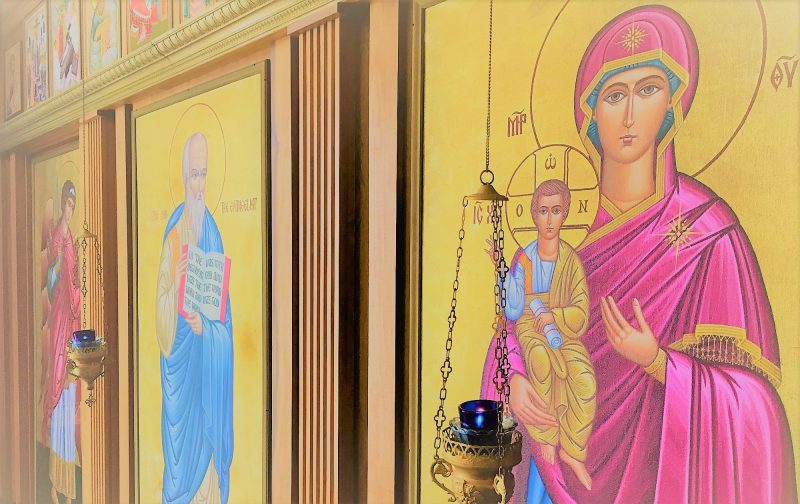
Icons hold a special place in the hearts of Orthodox Christians. Like photographs of our loved ones on earth, icons serve as a visual reminder of our departed brothers and sister in Christ. They also play a key part in the liturgical life and worship of the Church, teaching us about Christ, His Passion, and His Saints who followed after Him. The world of Orthodox iconography is quite vivid and interesting! In this post, we share four things we bet you didn’t know about icons in the Orthodox Church.
5 minutes
1. Icons are windows into heaven
Many people simply believe icons are nice works of religious art. However, icons are essential to Eastern Orthodox Christian worship, theology, and devotion. They are not just decorations for the church’s walls. We consider them “windows into heaven” for the following reasons:
- Communion with the holy
Icons allow us to commune with the holy figures depicted within them (the prototype). Through veneration of the icons, we receive divine grace, which draws us closer to God. - Becoming part of the Body
Icons remind us that we are part of a community that extends beyond those we can physically see in the room with us. The Saints are part of the Body of Christ just as we are! - Pictorial Theology
Icons express the Gospel message in images, in the same way that Scripture does with words. It explains our theology to those who may not understand our language. - Inverse perspective
Iconographers use inverse perspective when writing icons, putting the vanishing point at the viewer’s heart. They do this to communicate that God is revealing Himself through his holy ones. - Heads are almost perfectly round
In icons, the heads of holy figures are almost perfectly round to convey that the viewer is seeing the total revelation of the person.
2. True iconographers do not sign their icons
The next time you admire a piece of art, you will most likely see the artist’s signature in one of the corners. However, this is not the case with Orthodox icons. There are no signatures or recognition given to the iconographer on the front of the icon. On the back, often for marketing and copyright purposes, the name of the iconographer and company will be displayed. But never on the front.
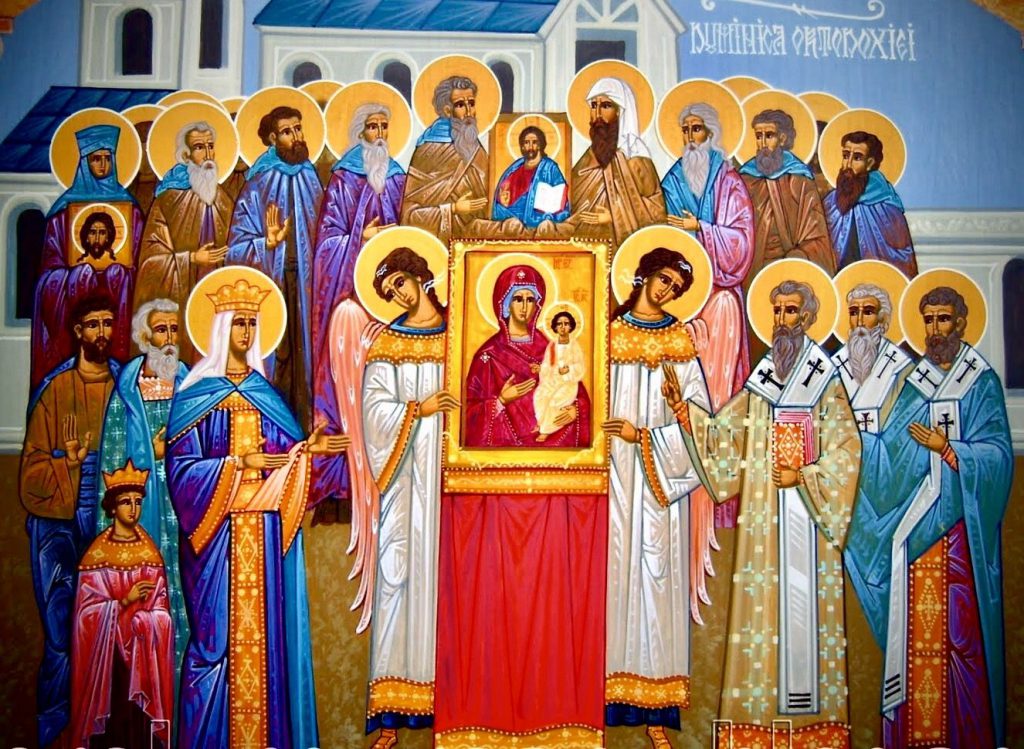
Why is this? Because the focus in Orthodox Christian iconography is on the divine image depicted rather than the individual artist. Since the icon is a window into heaven and not a personal expression like most other art, the artist’s ego becomes secondary to the sacred subject in the icon. Essentially, ego becomes completely irrelevant when one writes an icon.
3. Every color means something different
Every color used in Orthodox iconography carries a specific meaning.
| Gold | Reserved for Christ, symbolizes the divine nature and uncreated light of God |
| Blue | Symbolizes the kingdom of God (dark blue for the Mother of God, shows her heavenly nature) |
| Red | Signifies life on earth, symbolizes life-giving energy, love, passion, and Christ’s sacrifice. Symbol of the saving nature of the resurrection. |
| Green | Symbol of eternal hope, flowering, youth, and nature. Typically used to denote where life begins (ex. icons of the Nativity and the Annunciation). |
| White | Stands for divine light, purity, and holiness. White clothes typically indicate those who lived a good life obedient to the Lord. |
| Black | Symbol of death and evil, used to depict satanic beings, demons, and the abyss. Can also symbolize the renunciation of secular pleasures (as is the case with monks and nuns). |
| Purple | Color of royalty, shows the glory of Jesus Christ and the Theotokos. |
Related: A Guide To Liturgical Colors In The Orthodox Church
When iconographers use brighter versions of colors, they do so to depict happiness, joy, and the bliss of the Faith. This makes sense, when you consider that brighter colors incorporate the use of white. Similarly, when an iconographer uses darker colors in his/her writing, this serves to illustrate the struggles of the Faith, as well as ascetism and monasticism. This also makes perfect sense, when we take into account what black represents in Orthodox icons.
4. The long noses and high foreheads are intentional
You may have noticed that the persons depicted in Eastern Orthodox icons have rather unrealistic features. Their foreheads are often quite large, noses elongated, lips stout and closed. This is deliberate!
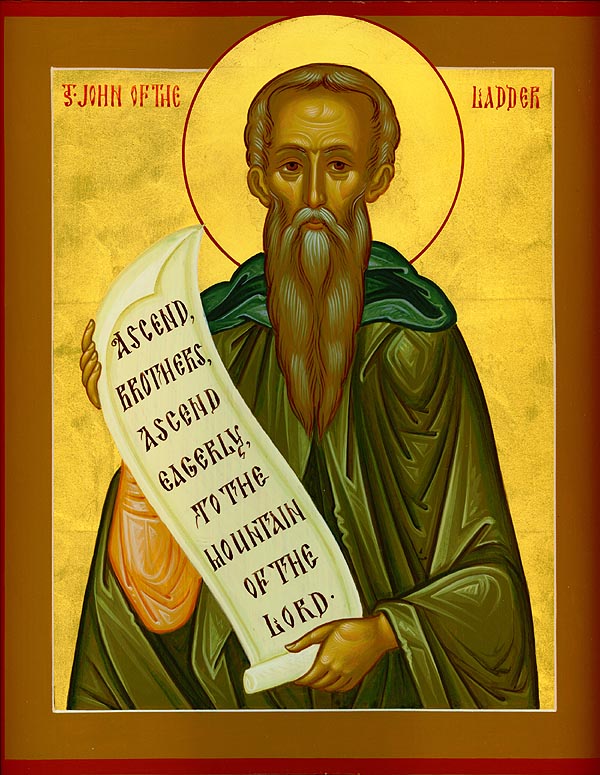
The physical features of the person depicted in the icon are symbolic of their spirituality. The high forehead conveys their spirituality and wisdom. Monks and holy people are often given deeper wrinkles to symbolize their knowledge. The elongated nose symbolizes the saint’s attunement to the incense of prayers rising to Heaven. Finally, the closed lips remind the viewer of the importance of silence and staying the tongue.
Conclusion
The world of Orthodox iconography is just as vast as the Faith itself. Every color has meaning, every physical characteristic depicts part of the revelation God has given to us. How amazing, for our Faith to be so deep that even in a lifetime of practicing it, we would not even skim the surface of these waters.
Are there other interesting facts about Orthodox iconography you think we should know? Share them in the comments below!
Keep Reading: A Guide To Orthodox Liturgical Vestments
11 Responses
In my own experience a small icon of St Ambrose of Optina, who I embraced as my personal saint, has given me important messages at times when I was misbehaving. I had blue tacked it to my bedroom wall, and one morning I was doing some stretches before I did my morning prayers when it “popped” off the wall of it’s own accord, coming face down on the carpet below, about 8 or so inches from the wall. There had been no earthquake or wind!! I felt I was being told to go straight into my prayers, bypassing any exercises, out of respect for God.
Are Icons depicting the father venerable??? my friend gave me an icon and a crucifix, the crucifix being the form of the orthodox cross, and an Icon, depicting Jesus, the father, and the holy spirit. I hear that most icons of the father are uncanonical because the father is incorporeal and subjecting to him to a human body or aging is heretical. but I still really liked the icon and found it funny at the same time, so I venerated The father through the icon. but, to put it simply my question is: are icons of the father venerable???
Jack,
Good to hear from you again! This is a thoughtful question, and it’s great that you’re seeking to understand the tradition behind the icons you use in prayer!
In the Orthodox Church, there is a clear teaching about how – and whom – we depict in icons. The Seventh Ecumenical Council (Nicaea II, 787) affirmed that icons can be made of Christ, the Theotokos (Mary), the angels, and the saints because they either took on human flesh (like Christ) or were seen in visible form (like the angels). But when it comes to God the Father, the teaching is different.
The Orthodox Church does not approve of icons that depict God the Father as an old man or with any human features. The reason is theological: the Father is “invisible, incomprehensible, without beginning,” as we say in the Divine Liturgy. Only the Son (Jesus Christ) became human and was seen by people—so only Christ is properly depicted in human form. St. John of Damascus, one of the great teachers of icons, wrote: “It is impossible to represent the invisible, incorporeal God, the Father. He cannot be depicted.” (St. John of Damascus, On the Divine Images, Book I, 7).
Sometimes you’ll see icons of the “Old Testament Trinity” (the three angels who visited Abraham in Genesis 18), which is a symbolic depiction of the Trinity, not a literal picture of the Father, Son, and Holy Spirit as three men. You might also see certain Western-style icons that show the Father as an elderly man, often next to Christ and the Holy Spirit as a dove. These are not considered canonical or proper for veneration in Orthodox tradition, because they can confuse our understanding of God.
If you have an icon that depicts the Father in human form, the Orthodox Church would encourage you not to venerate it in the same way you would venerate an icon of Christ or the saints. It’s not because you did anything wrong out of ignorance, but because the Church wants to safeguard the mystery and reality of who God is.
It’s good that you’re asking these questions and wanting to honor God in the right way. If you’re ever unsure about a particular image, your parish priest or spiritual father would be a good person to ask. The important thing is the love and reverence in your heart as you seek to glorify God “in spirit and in truth” (John 4:24). God bless!
Well, What about the holy spirit??? The icon I have depicts the Holy spirit as a dove, because he came down to Earth as a dove that one time. are depictions of the holy spirit prohibited???
Jack,
Great follow-up question! The Orthodox Church’s tradition with icons is very careful, and the way we depict the Holy Spirit is actually a bit different from how we treat depictions of God the Father.
The Holy Spirit, like the Father, is invisible and without a body. However, the Church allows the Holy Spirit to be depicted in certain specific ways, but only because He chose to reveal Himself in those visible forms at particular moments in Scripture. For example, at the Baptism of Jesus, the Holy Spirit appeared “in bodily form, like a dove” (Luke 3:22), and at Pentecost, the Holy Spirit appeared as “tongues of fire” (Acts 2:3). Because of these scriptural events, it is considered acceptable in Orthodox iconography to depict the Holy Spirit as a dove in icons of the Baptism of Christ (Theophany), or as tongues of fire in icons of Pentecost. These aren’t meant to show us what the Holy Spirit “looks like” in Himself, but rather to remind us of the moments when He made Himself known in these forms.
That means your icon is following tradition, as long as the Holy Spirit is shown as a dove in the context of the Baptism or another biblical event where He appeared that way. What the Church doesn’t do is invent new ways of depicting the Holy Spirit, or try to show Him in human form, since He has never taken on flesh. We hope this helps – God bless!
Well, since the father is incorpreal and without bodily form… how do I venerate him without the use of icons???
Jack,
When we venerate icons, we are not venerating the divine essence itself, but the person depicted. Icons of Christ are central because Christ is the eternal Son who “became flesh and dwelt among us” (John 1:14). He is the “image of the invisible God” (Colossians 1:15); in seeing Christ, we see the Father (John 14:9). Thus, Christ is the icon of the Father.
We do not venerate the Father directly through an icon because He has not revealed Himself in any bodily form. Instead, our worship and veneration of the Father are expressed through prayer, participation in the sacraments, and love of neighbor. In the Divine Liturgy, we pray to the Father, through the Son, in the Holy Spirit. The veneration of Christ’s icon, as well as icons of the saints, always points us back to the mystery of the Holy Trinity, whose fullness is beyond all human depiction. We hope this helps – God bless!
I have an Icon of St Photini and her 5 sisters, 2 sons with St Sebastian the Duke. All martyed as well as St Photini. What puzzles me is that most of the Saints, including St Photini, are not looking at me(so no eye contact) but are looking off in the distance. Is there an explanation for this, any spiritual significance?
Photini,
Christ is in our midst! That’s a thoughtful observation, and you’re not alone in noticing this. The way saints are depicted — especially their gaze and posture — carries deep spiritual meaning rooted in the theology and tradition of the Church. As you may already know, Orthodox icons serve as “windows to heaven,” drawing us into the reality of the Kingdom of God. The saints are depicted as transfigured, already living in the presence of God, and their gaze reflects this. When a saint in an icon is not looking directly at us, it symbolizes that their attention is fixed on God. Their eyes look “beyond” into eternity, toward Christ, or into the mystery of the divine. This distant gaze reminds us that holiness is about being oriented toward God, not toward the world. It also invites us, the viewers, to join them in that same turning of the heart, to lift our eyes and souls toward the things above (cf. Colossians 3:1-2).
Rather than demanding our attention or affection, the Saints in icons gently invite us to follow their example and look where they are looking, to seek Christ as they do. In this way, icons are not so much about “meeting the gaze” of the saint, but about being drawn into their spiritual vision.
Sometimes, especially in certain feast icons or more recent iconography, you will find saints who do look directly at the viewer, symbolizing their intercession or personal care. But the more traditional style is as you describe: the saint’s gaze is meditative, peaceful, and directed toward God. Ultimately, the icon is a window, not a mirror—it’s not just about our encounter with the holy, but about being invited to participate in the life of God, as the saints do.
So when you see St. Photini and her companions looking into the distance, it is a gentle reminder: their lives, sufferings, and martyrdom were all oriented toward Christ and the eternal Kingdom. The icon invites you to make that same journey in your own heart. If you’re interested in learning more, you might enjoy reading “The Meaning of Icons” by Leonid Ouspensky and Vladimir Lossky, which explores these themes in depth. God bless!
what about when Jesus is looking away from me??? it always seems like he is rolling his eyes or showing carelessness in icons where is looking away. could he be looking at his father??? but why would he, since they are consubstantial???
Jack,
Christ is Risen!
In Orthodox iconography, nothing is painted by accident—every detail is meant to reveal spiritual truth and invite us into a deeper relationship with God. When Christ’s eyes are not looking directly at us in an icon, it is not a sign of annoyance, impatience, or carelessness. Quite the opposite: icons are created to show us spiritual realities that cannot always be captured in a literal or “photographic” way.
Sometimes, Christ is depicted looking slightly away or with a gaze that seems distant. This is not to push us away, but to express His divine mystery, humility, and the fact that He is not only present with us, but also always in communion with the Father and the Holy Spirit. In icons, Christ’s gaze is often intentionally gentle, serene, or even searching – not as a human being impatiently rolling His eyes, but as the eternal Word of God, who sees and loves every person beyond what we can imagine.
Icons also invite us to seek, to wonder, and sometimes even to feel a holy longing. If Christ’s gaze seems turned away, it can be a gentle invitation for us to draw closer, to seek His face more deeply in prayer and in the life of the Church. The consubstantiality of the Son and the Father means they are of one essence and in perfect communion, but Christ also became truly human for our sake, so His gaze in icons always carries both divine mystery and human compassion.
If a particular icon stirs these questions or emotions, bring them to prayer. Ask Christ to reveal His love for you, even if at times He seems hidden or mysterious. Remember, His love and attention never wander from any of us, and in every icon—no matter the gaze. He is present, inviting us into communion with Himself and the Father through the Holy Spirit. We hope this helps – God bless!