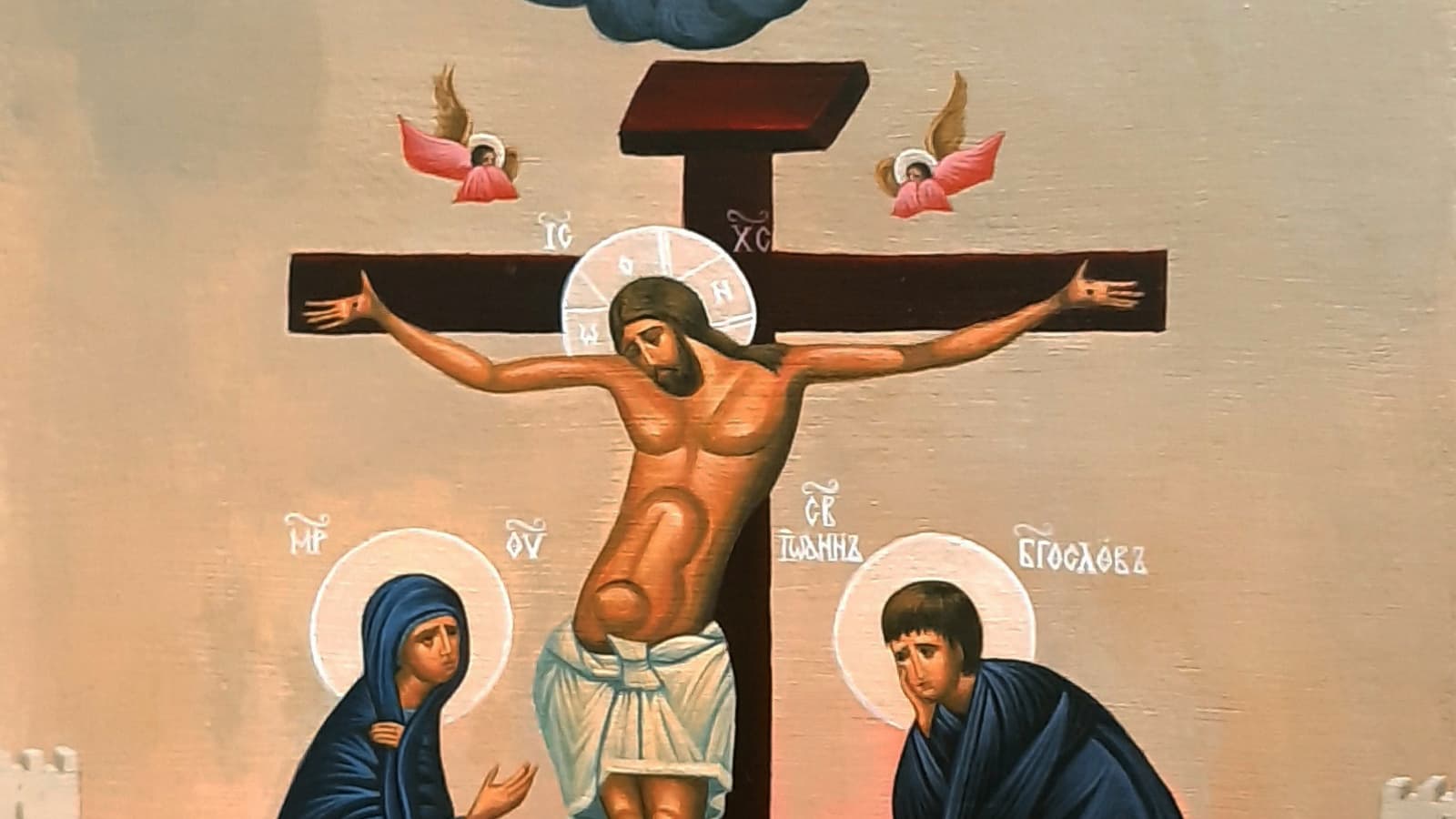
Great and Holy Friday stands at the very heart of Holy Week, inviting us to follow Christ to Golgotha. During the divine services on this day, we stand at the foot of His Cross, experiencing both sorrow and hope. For Orthodox Christians throughout the world, Holy Friday is both a day of mourning and of profound encounter with the mystery of God’s love.
4 minutes
Entering into the Mystery of the Cross
On Holy Friday, we remember the Passion and Crucifixion of our Lord Jesus Christ. The services, hymns, and readings of the day draw us into the reality of Christ’s suffering. Not as distant spectators, but as those who love Him and stand by Him in His hour of greatest humility.
The day begins with the reading of the Royal Hours, a series of psalms, prophecies, and New Testament readings that place the suffering of Christ in the broad sweep of salvation history. This service reminds us that the Cross was not an accident or defeat. Rather, it was the fulfillment of God’s loving plan for the redemption of the world.
The Vespers of the Unnailing: Christ’s body is taken down
In the afternoon, we gather for the Vespers of the Unnailing (the “Apokathelosis”). This service commemorates Joseph of Arimathea taking down Christ’s body from the Cross and lovingly preparing it for burial. The Gospel reading recounts the courage of Joseph, who asks Pilate for the Lord’s body, and the devotion of Nicodemus, who brings spices for burial.
During this service, the priest removes the icon of Christ’s body from the Cross and wraps it in a white cloth, placing it in the sanctuary as a sign of Christ’s rest in the tomb. In many parishes, the priest solemnly carries the “Epitaphios” (a richly embroidered cloth icon depicting Christ laid out for burial) and places it in a flower-adorned bier in the center of the church. This becomes the focal point for prayer and veneration throughout the rest of Holy Friday and into Holy Saturday.
The Lamentations at the tomb: Singing with love and sorrow
As evening falls, the Church gathers for the Matins of Holy Saturday, celebrated on Friday night. This is the Service of the Lamentations (Epitaphios Thrēnos), one of the most moving moments in the Orthodox liturgical year. The faithful stand around the tomb of Christ, joining the myrrh-bearing women in mourning and love.
The service is centered around the chanting of the “Lamentations” or “Praises” (Enkomia)—a series of poetic hymns sung in three sections, interwoven with Psalm 118 (“Blessed are You, O Lord, teach me Your statutes”). These hymns express both sorrow at Christ’s death and hope in His coming Resurrection:
“O Life, how can You die?
How can You dwell in a tomb?
Yet by Your death, You have destroyed death,
and You give life to all the world.”
The church is often dimly lit, candles flickering as the faithful sing together, “Holy God, Holy Mighty, Holy Immortal, have mercy on us.” At the end of the service, there is a solemn procession around the church, symbolizing Christ’s passage through death and His descent into Hades.
Why do we lament?
The Lamentations are not just an expression of grief but a proclamation of faith. The Church teaches us that Christ’s death is not only a moment of unspeakable loss but also the beginning of our victory over death.
As we mourn, we also anticipate the joy of Pascha. The “tomb” is not the end, but the threshold of new life.
How can we participate in Holy Friday?
- Attend the Services: Even if you cannot be present for every service, try to attend at least the Lamentations on Friday night. Stand or sit near the Epitaphios, listen to the hymns, and let the words and melodies draw you into the mystery of Christ’s love.
- Venerate the Epitaphios: It is customary to approach the bier, bow, and kiss the Epitaphios as a sign of devotion. This act unites us with the myrrh-bearing women and all who loved Christ.
- Reflect and Pray: Take time to read the Passion Gospels and the hymns of Holy Friday. Reflect on Christ’s sacrifice and what it means for you personally.
- Join the Procession: If your parish holds a procession, join with the faithful if you are physically able, remembering that Christ has sanctified even death by His presence.
A day of hopeful sorrow
Great and Holy Friday is a day of silence, fasting, and awe. It is a day to set aside distractions and stand with the Mother of God and the disciples at the foot of the Cross. It is a day to let our hearts be broken by the love of God—a love that goes to the very depths of suffering to bring us back to life.
As we keep watch at the tomb, we do so with hope. For even now, the dawn of the Resurrection is drawing near.
May your Holy Friday be blessed, a time of deep encounter with the love and mystery of our Lord’s sacrifice.
Keep Reading: Great and Holy Pascha: The Resurrection of Our Lord Jesus Christ